


Rhinoplasty Without General Anesthesia: Twilight Nose Job
Content
If you've been thinking about a nose job, there's a good chance one part worries you more than the rest. It's not the result. It's being put under.
You're not alone in that. And you may not need general anesthesia at all.
Dr. Russel Palmer, a board-certified plastic surgeon in Fort Lauderdale, prefers IV sedation for rhinoplasty. You are fully asleep and feel nothing. But you breathe on your own, with no breathing tube. He also doesn't use nasal packing, which is the part many people dread most about the first few days.
Here's how it works, what the studies say, and how to know if it's right for you.
Key takeaways
With IV sedation, you're asleep and comfortable during rhinoplasty, but you breathe on your own.
A 2026 review of 43 rhinoplasty studies found no difference in complication rates between general anesthesia, sedation and local anesthesia.
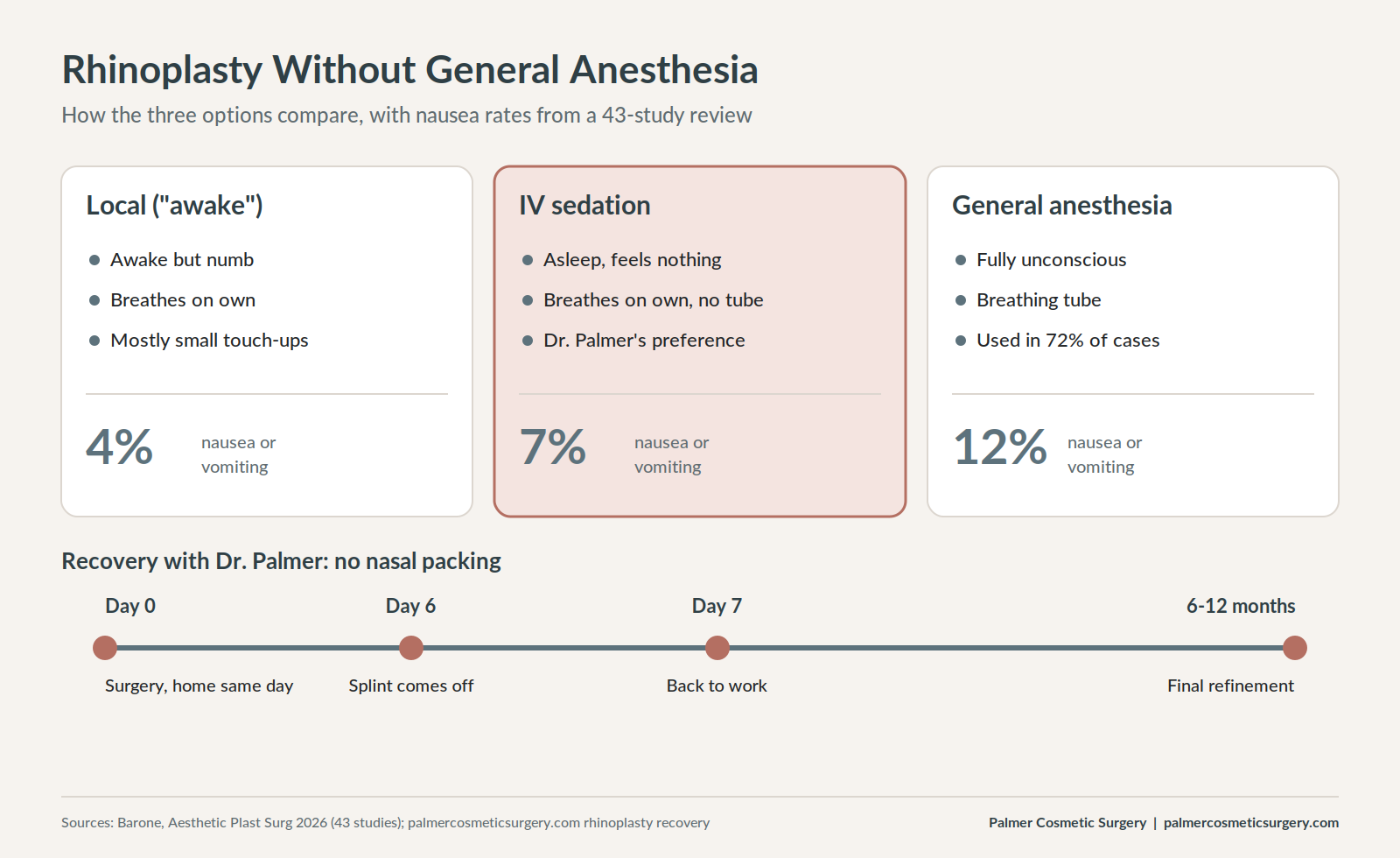
Nausea was less common with sedation (7%) than with general anesthesia (12%) in that review.
Dr. Palmer doesn't pack the nose after surgery. The same review linked little or no packing with less discomfort and a quicker recovery.
Most patients take about a week off work. Splints usually come off around day six.
Can you really have a nose job without being put under?
Yes. General anesthesia is still the most common choice for rhinoplasty. A 2026 review of 43 studies found it was used in 72% of cases (Barone et al., Aesthetic Plastic Surgery).
But that leaves more than a quarter of patients who had something else: IV sedation, or local numbing with a light sedative. And the review's main finding was reassuring. Complication rates were not significantly different across the three types of anesthesia. The authors concluded that all of them appear safe when the patient is well chosen.
So what do the words mean?
Local anesthesia ("awake"). The nose is numbed. You may get a calming pill. You're awake but comfortable. This is mostly used for small touch-ups.
IV sedation ("twilight"). Medicine through an IV puts you to sleep. You breathe on your own. This is what Dr. Palmer prefers.
General anesthesia. You're fully unconscious, and a machine helps you breathe through a tube.
Why skip general anesthesia for rhinoplasty?
The short answer: many people simply feel better afterward.
In a prospective study of facial plastic surgery patients, most of whom were having rhinoplasty, deep IV sedation was compared with general anesthesia (Jumaily et al., American Journal of Otolaryngology). The IV sedation group had:
Less nausea: 21.7% vs. 50%
Less vomiting: 4.3% vs. 37.5%
Faster wake-up: 4 minutes vs. 13 minutes
They also rated their recovery higher on a standard survey. No one in either group had a complication.
Nausea matters more after nose surgery than you might think. Your nose is swollen and sore. Your throat may be dry. Throwing up in that state is miserable, and straining is the last thing a healing nose needs. Lowering that risk makes the first night much easier.
There's also no breathing tube, so there's no sore throat from it.
No packing: the other comfort upgrade
Ask people what they've heard about nose jobs, and many will mention the packing. That's gauze or sponges placed inside the nose after surgery. It can make breathing through your nose impossible for a day or more, and taking it out is not fun.
Dr. Palmer doesn't use nasal packing. His approach is designed to limit bleeding and bruising during surgery, so packing isn't needed.
The research supports this direction. The same 2026 review found that packing is increasingly avoidable in routine rhinoplasty. Little or no packing was linked with less discomfort and a quicker recovery, without more bleeding after surgery (Barone et al.).
Put IV sedation and no packing together, and the first 48 hours look very different from what many people expect.
What the day of surgery looks like
Before. You meet with Dr. Palmer to plan your nose. He looks at the structure of your nose, how you breathe, and how your nose fits the rest of your face. Some patients need bloodwork first.
Surgery. You come to our AAAASF-accredited surgical suite in Fort Lauderdale. The IV goes in and you fall asleep. Dr. Palmer's preferred approach is closed rhinoplasty. That means the incisions are inside the nose, with no outside scar. (Our guide to preservation rhinoplasty explains why he prefers it.)
Right after. You wake up in the recovery area. Once you're ready, a friend or family member drives you home. You'll wear a splint on the outside of your nose.
The first week. Swelling and some bruising are normal. Most people take about 7 days off work. The splint usually comes off around day six, and that's when you get your first look.
The next year. Your nose keeps refining as swelling fades. Results continue to improve over 6 to 12 months.

Rhinoplasty by Dr. Russel Palmer. Individual results vary.
Your nose is planned around your whole face
A nose never stands alone. It sits between your eyes, your cheeks, your lips and your chin. A change that looks great in a close-up photo can look off when you see the whole face.
That's why Dr. Palmer looks at the full face before he plans a nose. He checks how the bridge lines up with your brow. He checks how the tip sits above your upper lip. He looks at your profile, and he looks at how your chin balances your nose. Sometimes a small change to the tip does more than a big change to the bridge.
This matters for anesthesia, too. A plan that's focused and well thought out tends to mean a shorter, smoother surgery. And shorter surgery under sedation is easier on your body.
Making the first few days easier
A few simple habits help most people feel better faster after rhinoplasty:
Sleep with your head up. Two pillows or a wedge pillow help swelling drain.
Use cool compresses on your cheeks. Keep them off the splint itself.
Skip blowing your nose. Gently wipe instead. Your care team will tell you when it's safe.
Wear glasses with care. Ask before resting heavy frames on your nose.
Plan quiet days. Easy walks are good. Bending, lifting and hard workouts can wait.
You'll get written instructions before surgery, and Dr. Palmer’s team is available if anything worries you. Follow-up visits are included at no extra cost.
Who is a good candidate for rhinoplasty under IV sedation
Most healthy rhinoplasty patients do well with IV sedation. The careful part is screening.
Nose surgery happens right next to your airway. That's one reason close monitoring is so important with sedation. A review of anesthesia for office-based facial surgery notes that some patients should be steered toward an anesthesiologist-run plan instead. These include people with severe sleep apnea, serious liver disease, or a high-risk health rating (Bharadwaj et al., World Journal of Otorhinolaryngology).
You're likely a good fit if:
You're healthy overall, or your conditions are well controlled
You don't smoke, or you can stop before and after surgery
You're at least 15 years old and your nose has finished growing
You'd like to avoid a breathing tube and a groggy wake-up
You may need a different plan if:
You have severe sleep apnea
You have major heart or lung problems
Your surgery is very complex and will run long
Dr. Palmer will go over your health history at your consultation and explain which option is safest for you.
Breathing problems, too
Rhinoplasty isn't only about looks. Many people want a nose that works better as well as one that looks better. A crooked inner wall (deviated septum) or blocked airway can often be fixed in the same surgery, under the same sedation.
If breathing is part of your reason for surgery, say so at your consultation.
Not ready for surgery? Liquid rhinoplasty
Some people want a small change without surgery at all. A liquid rhinoplasty uses filler to smooth a bump or lift the tip. It takes under 30 minutes and usually lasts up to 12 months. It can't make a nose smaller or fix breathing. But for the right goal, it's a simple first step.
Questions to bring to your consultation
Will I have IV sedation, and who will monitor me?
Will my rhinoplasty be closed or open, and why?
Will you also address my breathing?
How long will my surgery take?
When will the splint come off, and when can I go back to work?
What should I do in the first 48 hours to keep swelling down?
Frequently asked questions
Can you be awake for a nose job?
For a full rhinoplasty, Dr. Palmer uses IV sedation, so you're asleep and comfortable while breathing on your own.
Is IV sedation safe for rhinoplasty?
A 2026 review of 43 studies found no difference in complication rates between sedation and general anesthesia for rhinoplasty. Safety depends on careful screening and monitoring, which is why your health history matters.
Do you have packing after rhinoplasty?
Not with Dr. Palmer. He doesn't use nasal packing. You wear an outside splint for about six days.
How long is recovery after rhinoplasty under IV sedation?
Most patients take about a week off work. The splint comes off around day six. Swelling keeps gradually fading over 6 to 12 months.
Will I feel anything during surgery?
No. With IV sedation you're asleep, and the area is numbed.
Can I combine rhinoplasty with other procedures under sedation?
Yes. Many patients pair rhinoplasty with eyelid surgery, a brow lift or even a facelift. It all happens under the same IV sedation, in one trip to the operating room, with one recovery. Dr. Palmer will look at the total surgery time and your health before recommending a combined plan.
Plan your rhinoplasty without general anesthesia
A new nose should start with a calm, clear plan. Dr. Palmer will look at your nose, your breathing and your goals, then explain how your surgery and sedation would work. Book a private consultation at our office in Fort Lauderdale, or call (954) 989-5001. Financing options are available. Browse rhinoplasty results, or read about facelifts without general anesthesia if you're planning more than one procedure.
Sources
Barone M, et al. Anesthesia Modalities and Nasal Packing in Rhinoplasty: A Systematic Review of Complications, Postoperative Management, and Safety Guidelines. Aesthetic Plastic Surgery. 2026.
Jumaily JS, et al. Quality of Recovery and Safety of Deep Intravenous Sedation Compared to General Anesthesia in Facial Plastic Surgery: A Prospective Cohort Study. American Journal of Otolaryngology. 2022.
Bharadwaj S, et al. Anesthesia for Office-Based Facial Plastic Surgery Procedures. World Journal of Otorhinolaryngology – Head and Neck Surgery. 2023.
American Society of Anesthesiologists. Statement on Continuum of Depth of Sedation. Amended 2024.