


Preservation Rhinoplasty: Who It's For and How It Works
Content
Most people who want a nose job say the same thing first. "I just want it to look like me, only better."
That's exactly the idea behind preservation rhinoplasty.
Instead of shaving down a bump and rebuilding the bridge, a preservation approach keeps the natural top of your nose. It lowers or reshapes the bridge from underneath. The smooth lines that make a nose look natural stay in place.
Dr. Russel Palmer, a board-certified plastic surgeon in Fort Lauderdale, has used closed preservation rhinoplasty for many years. It's his preferred technique. All the incisions are inside the nose, so there's no outside scar.
Here's how it works, who it suits best, and when a different approach makes more sense.
Key takeaways
Preservation rhinoplasty keeps the natural roof of your nose and lowers or reshapes it from below, instead of removing and rebuilding it.
A closed approach puts every incision inside the nose. There's no visible scar.
It suits many first-time patients with a straight or gently curved profile, a small-to-moderate bump, and thin-to-medium skin.
A 2026 review of 855 patients found strong satisfaction rates
Some noses do better with a more traditional, "structural" approach. A consultation shows which one fits yours.
What "preservation" really means
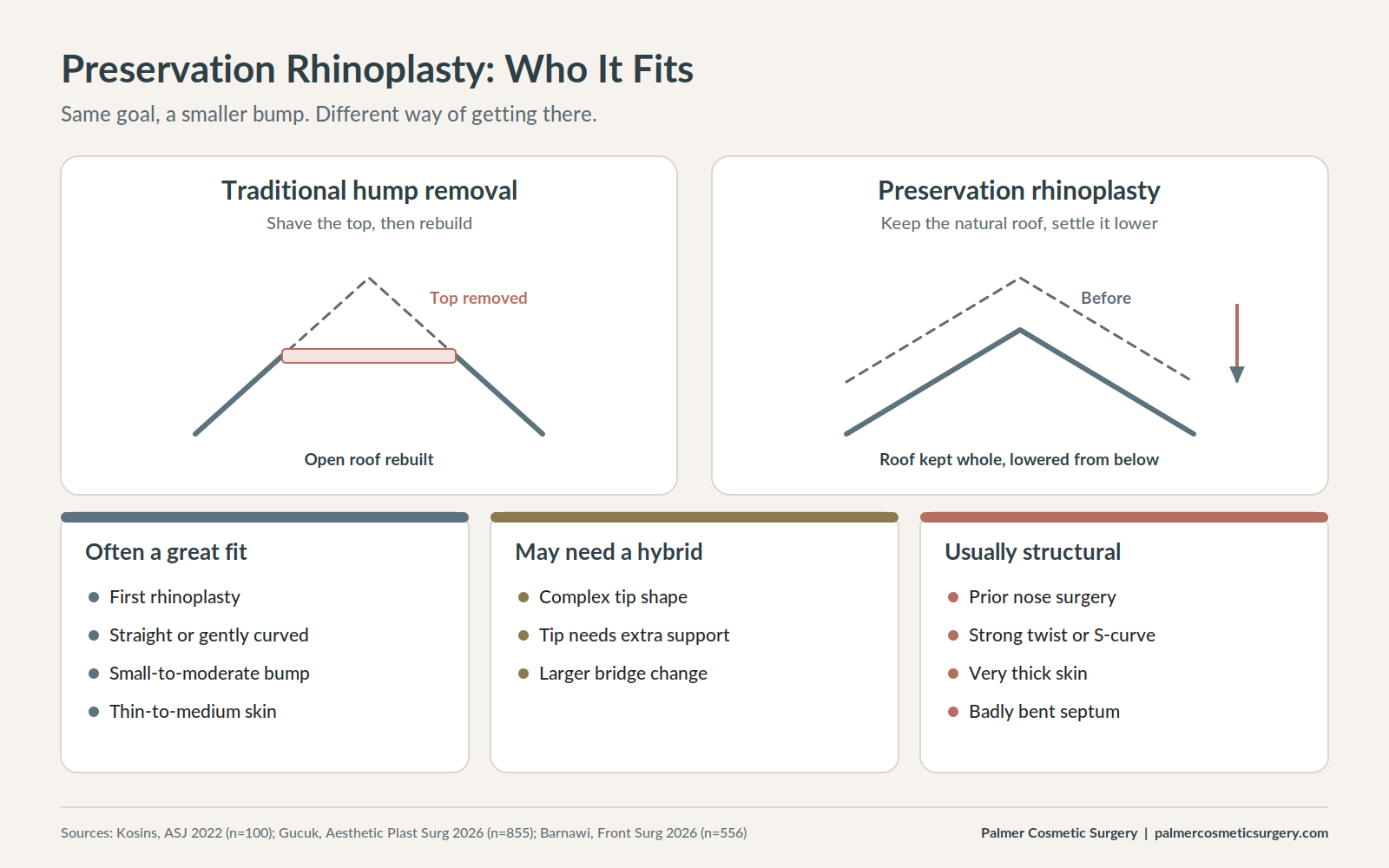
Think of the top of your nose as a roof. It's made of bone near your eyes and cartilage lower down. Where the two meet, there's a smooth curve that catches the light. That curve is a big part of why a nose looks natural.
In a traditional hump removal, the surgeon takes the top of that roof off. Then the open area has to be rebuilt so it's smooth and even. Done well, it gives great results. It's also more work, and the rebuilt bridge has to heal into a new shape.
Preservation rhinoplasty works differently. The surgeon leaves the roof in one piece. Then a small strip of tissue is removed from underneath, so the whole roof can settle lower. The bump goes down, but the top surface is never cut open.
There are a few versions of this idea. Some lower the whole bridge. Some focus on the surface only. Your surgeon picks the version that fits your nose.
Closed vs. open: where the incisions go
There are two ways to reach the inside of the nose.
Closed rhinoplasty. Every incision is inside the nostrils. Nothing shows on the outside. This is Dr. Palmer's preferred approach.
Open rhinoplasty. A small incision crosses the strip of skin between the nostrils. The skin is lifted so the surgeon can see everything directly. This helps for complex reshaping or major structural repair. Recovery can take a little longer.
Preservation rhinoplasty can be done either way. A 2022 study of 100 patients broke down when each approach worked best (Kosins et al., Aesthetic Surgery Journal):
Closed preservation was favored for thin skin, small changes to the bridge, simpler tip work, and noses that stick out too far.
Open preservation was favored for big changes to the bridge, S-shaped nasal bones, complex tip shapes, or when the tip needs more support.
Structural (traditional) rhinoplasty was always done open. It was preferred for complex bridge problems, major twists in the inner wall, and uneven middle sections.
Who is a great candidate
A review of 13 studies and 855 patients found preservation worked best for people having their first nose surgery, with a straight or slightly curved profile, little to moderate crookedness, and a stable, healthy structure inside the nose (Gucuk et al., Aesthetic Plastic Surgery). A separate review of 556 patients pointed to straight profiles, moderate bumps, and thin-to-medium skin (Barnawi et al., Frontiers in Surgery).
You may be a great fit if:
This is your first rhinoplasty
You have a bump on the bridge that you'd like lowered
Your nose is fairly straight when viewed from the front
Your skin is thin to medium in thickness
You want a natural change, not a dramatic new nose
A more traditional or "hybrid" approach often works better when:
You've had nose surgery before
Your nose has a strong twist or S-shaped curve
The wall inside your nose is badly bent and blocking your breathing
Your skin is very thick
The tip needs major reshaping or support
Neither group is "better." These are simply two good tools. Many surgeons blend them in the same operation, using preservation for the bridge and other methods for the tip.
What the studies show about results
Preservation rhinoplasty has grown fast over the last several years, and the early data is very encouraging.
In the 855-patient review, people rated their noses highly. One standard patient survey score for the nose rose from 37.6 before surgery to 88.2 after. A breathing-blockage score dropped from 45.6 to 18.4. Lower is better on that one. Revision rates ranged from 0% to 7.9% (Gucuk et al.).
The 556-patient review compared preservation directly with traditional methods. Safety and breathing results were about the same. In one included trial, patients' ratings of their nose's appearance were higher with a preservation technique at both 3 and 12 months (Barnawi et al.).
The reviewers are careful to note that most studies are still short-term. That's normal for a newer technique. But the direction is clear. For the right nose, preservation offers natural results with comparable safety.

Why Dr. Palmer prefers the closed preservation approach
A few things make closed preservation a good match for how Dr. Palmer works.
No outside scar. All incisions are inside the nose.
A natural-looking bridge. Keeping the roof intact helps avoid the over-scooped or "operated" look.
A smoother early recovery. Dr. Palmer generally doesn't use nasal packing. His surgery is planned to limit bleeding and bruising. Most patients take about 7 days off work, and the splint usually comes off around day six.
No general anesthesia. He performs rhinoplasty under IV sedation. You're asleep and comfortable, but you breathe on your own. Our post on rhinoplasty without general anesthesia explains what that's like.
When a nose needs more structural work, Dr. Palmer uses an open approach. The goal is always the same: the right method for your nose.
What to expect as your nose heals
Preservation rhinoplasty is gentle on the bridge, but your nose still needs time to settle. Knowing the timeline helps you enjoy each stage instead of worrying about it.
Week 1. You'll wear a splint. Your nose and the area under your eyes may be puffy, and some people bruise. Most patients rest at home and take about 7 days off work.
Around day 6. The splint comes off. This is your first real look. It will already look different, but it will also look swollen. That's normal.
Weeks 2 to 6. Most bruising fades. You'll feel ready for work, errands and social plans. Light exercise usually returns in this window, once you're cleared.
Months 3 to 6. The bridge looks more refined. Swelling is mostly gone from the top of the nose.
Months 6 to 12. The tip is the last part to settle. Thicker skin tends to hold swelling longer. By about a year, you're seeing your final shape.
You can take a picture from the same angle every few weeks. Small weekly changes are hard to see in the mirror, but they're easy to spot side by side.
And if anything ever feels off, Dr. Palmer’s team is just a phone call away. Follow-up visits are included at no extra cost.
What happens at your consultation
Your consultation is where the technique gets chosen. Dr. Palmer will:
Look at your nose from the front, side and below
Feel the bridge and tip to judge your skin thickness and support
Check your breathing and the wall inside your nose
Look at how your nose balances with your eyes, lips and chin
Talk about your goals in your own words
From there, he'll explain whether a closed preservation approach fits, or whether your nose would do better with another method. You'll leave knowing what the plan is and why.
Questions to bring to your consultation
Am I a good candidate for preservation rhinoplasty?
Will my surgery be closed or open?
How will you handle my tip?
Will you also improve my breathing?
How long will I wear a splint, and when can I go back to work?
How much swelling should I expect at 3 months, and at a year?
Frequently asked questions
What is preservation rhinoplasty?
It's a nose surgery technique that keeps the natural top of your nose in one piece. The bridge is lowered or reshaped from underneath, instead of being removed and rebuilt.
Is preservation rhinoplasty better than traditional rhinoplasty?
It's not better for everyone. For the right nose, studies show similar safety and breathing results, with very natural-looking bridges. Some noses still do best with a traditional approach.
Does closed rhinoplasty leave a scar?
No outside scar. All incisions are inside the nostrils.
Can preservation rhinoplasty fix breathing?
Often, yes. Breathing problems inside the nose can usually be treated in the same surgery. Severe twists may need additional techniques.
Is preservation rhinoplasty done under general anesthesia?
Not at Palmer Cosmetic Surgery. Dr. Palmer performs rhinoplasty under IV sedation. You're asleep and comfortable, and you breathe on your own without a breathing tube.
Can I have preservation rhinoplasty if I've had a nose job before?
Usually, a revision nose needs a more traditional or hybrid approach. Dr. Palmer can tell you after an exam.
Find out if preservation rhinoplasty is right for you
The best nose is one that looks like it was always yours. Dr. Palmer will examine your nose, listen to your goals, and explain which approach fits. Book a private consultation at our office in Fort Lauderdale, or call (954) 989-5001. Financing options are available. You can also browse rhinoplasty results and learn more about rhinoplasty at Palmer Cosmetic Surgery.
Sources
Kosins AM, et al. Preservation Rhinoplasty: Open or Closed? Aesthetic Surgery Journal. 2022.
Gucuk D, et al. Shaping the Future of Nasal Surgery: A Systematic Review of Preservation Rhinoplasty. Aesthetic Plastic Surgery. 2026.
Barnawi, et al. Comparison of Preservation Rhinoplasty Versus Conventional Rhinoplasty Techniques: A Systematic Review of Aesthetic and Functional Outcomes. Frontiers in Surgery. 2026.
American Society of Plastic Surgeons. Rhinoplasty.