


Facelift Without General Anesthesia: Awake vs. Twilight
Content
A lot of people want a facelift. Far fewer want to be put under general anesthesia for one.
That's a fair feeling. General anesthesia means a breathing tube, and for some people, a groggy, queasy day after. So it makes sense that searches for "awake facelift" and "twilight facelift" keep growing.
Here's the good news. You have choices. Dr. Russel Palmer, a board-certified plastic surgeon in Fort Lauderdale, performs his facelifts under IV sedation instead of general anesthesia. That includes his Tri-Nova Deep Plane Facelift. You're asleep and comfortable. But you breathe on your own the whole time.
This guide explains what the words really mean, what the research shows, and how to tell which option fits you.
Key takeaways
"Awake," "twilight" and "IV sedation" are not the same thing. They sit at different points on a scale.
With IV sedation, you are asleep and feel no pain, but you breathe on your own. No breathing tube is needed.
In one study, patients who had deep IV sedation had far less nausea and woke up faster than patients who had general anesthesia.
A 2026 series of 142 deep plane facelifts done without general anesthesia found no major bleeding and no facial nerve injuries.
The best choice depends on your health, the size of the operation, and how you feel about anesthesia. That's what a consultation sorts out.
The words patients use, and what they mean
People often mix these terms up. That's understandable, because they overlap. Doctors think of sedation as a dial, not a switch.
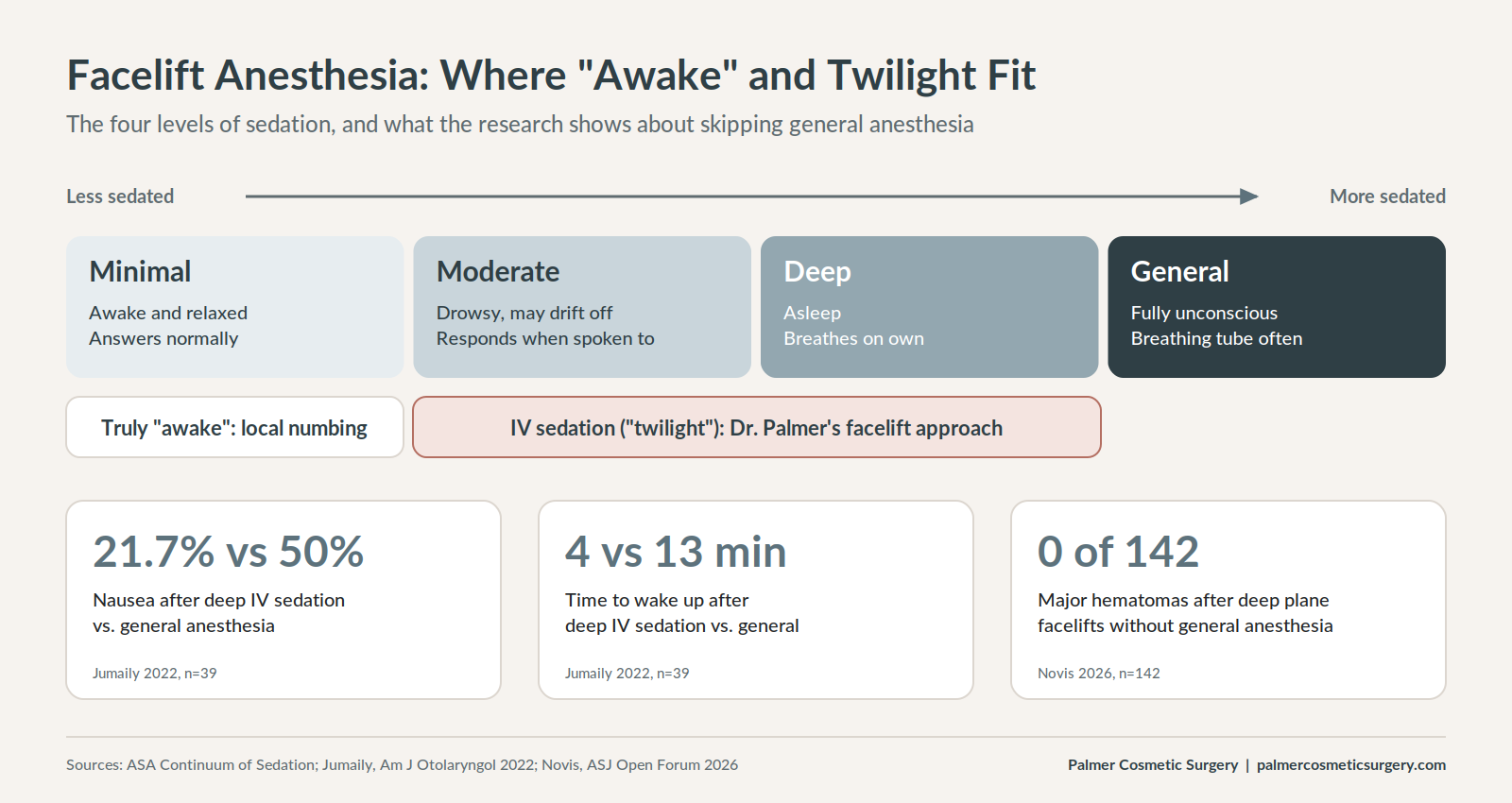
The American Society of Anesthesiologists describes four levels (ASA statement on depth of sedation):
Minimal sedation. You're relaxed and awake. You answer questions normally. Think of a single calming pill.
Moderate sedation. Often called "conscious sedation." You're drowsy and may drift off, but you respond when spoken to.
Deep sedation. You're asleep and not easily woken. You still breathe on your own.
General anesthesia. You're fully unconscious. Most patients need help breathing, often with a tube.
So where does "awake" fit? A truly awake facelift uses local numbing medicine, sometimes with a calming pill. "Twilight" is a loose term. Most people use it to mean IV sedation somewhere in the moderate-to-deep range.
At Palmer Cosmetic Surgery, facelift patients receive IV sedation. You are asleep, you feel no pain, and you don't need a breathing tube.
Why some patients prefer to skip general anesthesia
The biggest reason people give is simple. They want to feel more like themselves when they wake up.
A prospective study compared deep IV sedation with general anesthesia in 39 facial plastic surgery patients. Most were having nose surgery. The results were clear (Jumaily et al., American Journal of Otolaryngology):
Nausea: 21.7% with IV sedation vs. 50% with general anesthesia
Vomiting: 4.3% vs. 37.5%
Time to wake up: 4 minutes vs. 13 minutes
The IV sedation group also scored higher on a standard recovery survey. Neither group had a complication after surgery.
Why does nausea matter so much after a facelift? Retching raises your blood pressure. Your new lift is healing, and you want that area calm. A smoother wake-up is about more than comfort.
There are a few other things patients tend to like:
No breathing tube, so no sore throat
Less of the "hungover" feeling many people get after general anesthesia
Going home the same day with a friend or family member, after a short recovery in the clinic
What the research says about facelifts without general anesthesia
You might wonder whether a big operation like a deep plane facelift can be done well without general anesthesia. The evidence is encouraging.
A 2026 study looked at 142 patients who had a deep plane facelift and neck lift under local anesthesia with oral sedation. The surgery was done in an office surgical suite. At 90 days (Novis et al., Aesthetic Surgery Journal Open Forum):
No major hematomas (pooled blood that needs a return to surgery)
No facial nerve injuries
No blood clots in the legs or lungs
No hospital stays
The rates matched what's published for facelifts under general anesthesia.
A bigger picture comes from a review of 4,451 patients who had shorter-incision facelifts. Most of them, 84%, had local anesthesia or sedation. Only 16% had general anesthesia. The type of anesthesia was not linked to the complication rate (Amador et al., Aesthetic Surgery Journal Open Forum).
For deep plane facelifts in general, a 2026 review of 10,784 patients found an overall complication rate of 6.6%, with no permanent facial nerve injuries (Koroma et al., Aesthetic Plastic Surgery).
None of this means general anesthesia is wrong. It means a facelift without it is a well-studied option, not a shortcut.
What a facelift under IV sedation feels like
Here's what the day usually looks like at Palmer Cosmetic Surgery.
Before. You meet with Dr. Palmer to finalize the plan. Depending on your health, he may ask for bloodwork or an EKG. You get clear instructions on what to stop taking and when to stop eating.
The morning of. You arrive at the practice's AAAASF-accredited surgical suite in Fort Lauderdale. The IV goes in. Within a few minutes you drift off.
During. A Tri-Nova Deep Plane Facelift can take up to six hours. Dr. Palmer lifts the deeper layer of the face in three sections: the neck, the jawline and the lower face. Because the lift is done at the deeper layer, the skin isn't pulled tight. You stay asleep and breathe on your own throughout, while your vital signs are watched closely.
After. You rest in the clinic for a short time. Then a trusted adult drives you home. No drains are used.
The next two weeks. Most patients take one to two weeks off work. Normal day-to-day activity usually returns in 7 to 10 days. Hard exercise waits two to three weeks.
At your consultation, Dr. Palmer will walk you through each step and answer any questions about the anesthesia itself.
Who is a good fit for a facelift without general anesthesia
Most healthy facelift patients are good candidates for IV sedation. The 2026 deep plane study used clear limits worth knowing about. Patients on blood thinners, those with moderate to severe sleep apnea, and those with a BMI over 40 were not offered surgery that way (Novis et al.).
Here's a general picture of who tends to do well:
You're in good overall health, or your conditions are well controlled
You don't smoke, or you're willing to stop well before and after surgery
Your weight is stable
You'd rather avoid a breathing tube and a heavy wake-up
And who might need a different plan:
People with severe sleep apnea or certain heart or lung conditions
People who need blood thinners that can't be paused
People who feel strongly that they want general anesthesia

Facelift by Dr. Russel Palmer. Individual results vary.
Does the anesthesia change the result?
It shouldn't. The lift itself is the same operation. Dr. Palmer's facelift and Tri-Nova techniques use the same incisions and the same deep-layer work whether or not general anesthesia is involved.
What changes is how you feel on the way in and on the way out.
If you're still choosing between lift styles, our guide to deep plane vs. SMAS facelifts covers how the technique gets picked. And if you're weighing a facelift against a neck lift, see neck lift vs. facelift.
Other procedures that can skip general anesthesia
Facelifts aren't the only option. Dr. Palmer uses IV sedation for most of his surgeries, including rhinoplasty, breast surgery and tummy tucks.
A few procedures can be done truly awake, with local numbing only:
Upper eyelid surgery. It's often done under local anesthesia alone. It takes about an hour. See eyelid surgery.
Some brow lifts. Depending on the technique and your preference, a brow lift can use local anesthesia or IV sedation.
Smaller neck lifts. Less complex cases can sometimes use local anesthesia.
If you plan to add eyelid or brow surgery to your facelift, it all happens under the same sedation, in one trip to the operating room.
Questions to bring to your consultation
What level of sedation will I have, and will I remember anything?
Who will give and monitor my anesthesia?
How long will my surgery take, start to finish?
Is there anything in my health history that changes the plan?
If I add eyelid or brow surgery, how does that change the time and recovery?
When can I go home, and who should stay with me the first night?
Frequently asked questions
Can you be awake for a facelift?
Some surgeons do facelifts with local numbing and an oral sedative, so the patient is drowsy but awake. Dr. Palmer uses IV sedation, so you're asleep and comfortable while breathing on your own.
Is IV sedation the same as twilight anesthesia?
Mostly, yes. "Twilight" is an informal term. It usually means IV sedation that leaves you drowsy or asleep without a breathing tube.
Will I feel pain during a facelift under IV sedation?
No. You're asleep, and the area is also numbed. Afterward, most patients rate facelift soreness at about 6 out of 10 at its worst, and it eases a little more each day.
Is a facelift without general anesthesia safer?
Studies show less nausea and faster wake-up with IV sedation, and facelift complication rates without general anesthesia match published rates with it. The safest choice still depends on your health, so it's decided case by case.
How long does a facelift take under IV sedation?
A Tri-Nova Deep Plane Facelift can take up to six hours. Adding other procedures can add time.
See what a facelift without general anesthesia could look like for you
A facelift should feel like a good decision from the first day. Dr. Palmer will look at your face, review your health, and explain exactly how your surgery and sedation would work. Book a private consultation at our office in Fort Lauderdale, or call (954) 989-5001. Financing options are available. You can also browse facelift results and learn more about the Tri-Nova Deep Plane Facelift.
Sources
American Society of Anesthesiologists. Statement on Continuum of Depth of Sedation: Definition of General Anesthesia and Levels of Sedation/Analgesia. Amended 2024.
Florida Board of Medicine. Fla. Admin. Code R. 64B8-9.009, Standard of Care for Office Surgery. Effective September 16, 2024.
Jumaily JS, et al. Quality of Recovery and Safety of Deep Intravenous Sedation Compared to General Anesthesia in Facial Plastic Surgery: A Prospective Cohort Study. American Journal of Otolaryngology. 2022.
Novis S, et al. The Safety and Complication Rate of Deep Plane Facelift Under Local Anesthesia. Aesthetic Surgery Journal Open Forum. 2026.
Amador RO, et al. Safety and Effectiveness of Limited Incision Facelifts: A Systematic Review and Meta-analysis. Aesthetic Surgery Journal Open Forum. 2023.
Koroma P, et al. Deep Plane Facelifts: A Systematic Review and Meta-Analysis of Outcomes. Aesthetic Plastic Surgery. 2026.