


Hooded Eyes: Brow Lift or Eyelid Surgery? How to Tell
Content
You look in the mirror and your eyes look heavy. Friends ask if you're tired when you're not.
That look is called "hooding." And here's the part most people don't know. Hooding can come from more than one place.
Sometimes it's extra eyelid skin. Sometimes it's a brow that has slowly dropped. Sometimes it's both. Eyelid surgery, a brow lift, or the two together can each be the right answer.
Dr. Russel Palmer, a board-certified plastic surgeon in Fort Lauderdale, performs both eyelid surgery (blepharoplasty) and brow lifts. This guide walks you through how surgeons tell the causes apart, plus a simple check you can try at home.
Key takeaways
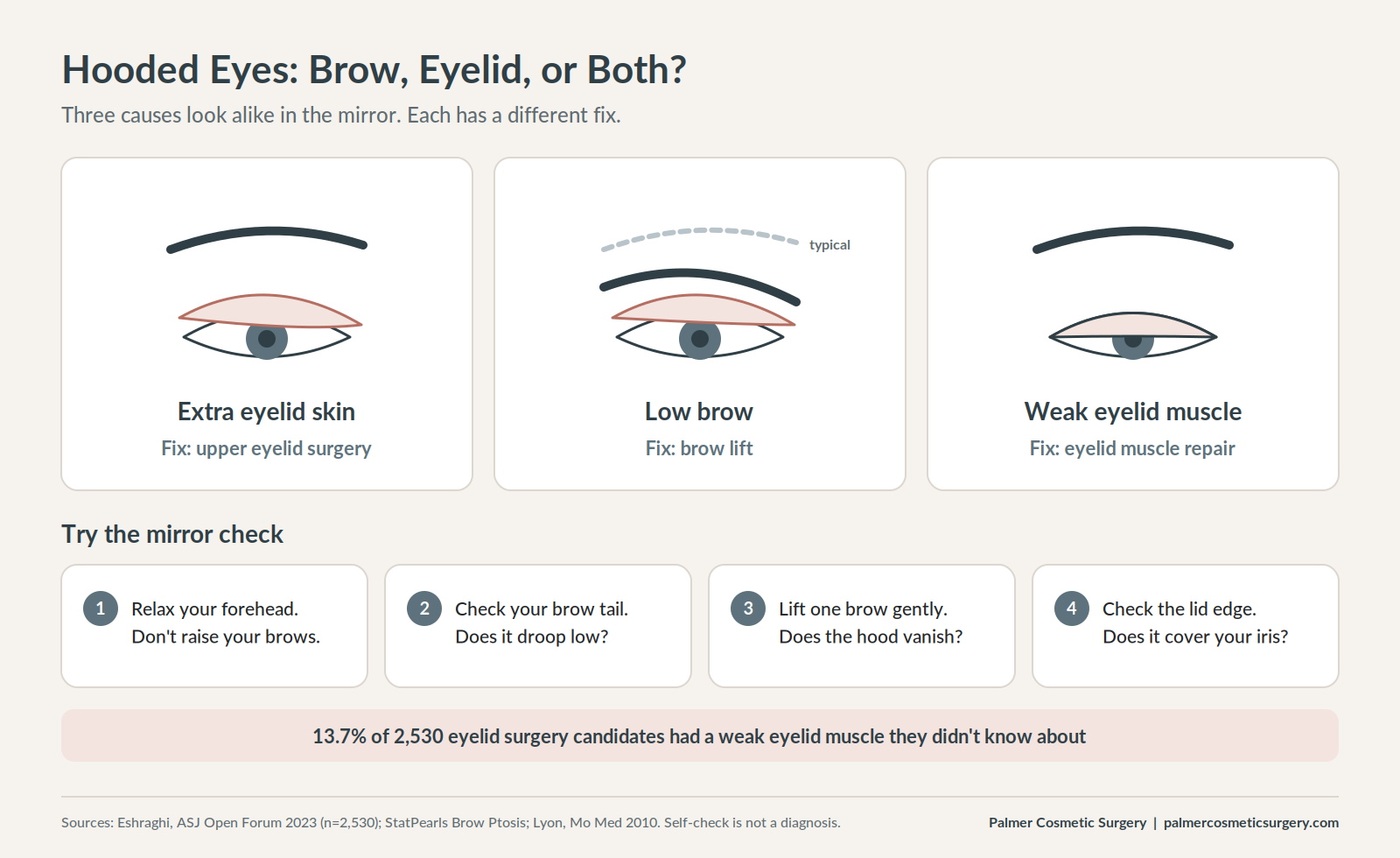
Hooded eyes have three main causes: extra eyelid skin, a low brow, or a weak eyelid muscle.
Extra skin is fixed with upper eyelid surgery. A low brow is fixed with a brow lift.
Many people have some of each, and the two surgeries are often done together.
In one study, about 1 in 7 people seeking eyelid surgery had a weak eyelid muscle they didn't know about.
Upper eyelid surgery can be done under local anesthesia and takes about an hour.
The three causes of hooded eyes
Think of the upper face as three layers that can each slip a little over time.
1. Extra eyelid skin. The thin skin of the upper lid stretches with age. It folds over the crease and can rest on the lashes. Doctors call this dermatochalasis. This is the classic reason for upper eyelid surgery.
2. A low brow. Your eyebrows are held up by your forehead. Over time, the brow can sink, especially at the outer tail. When it drops, it pushes skin down onto the lid. The lid looks heavy, but the real cause is above it. This is brow ptosis.
3. A weak eyelid muscle. The muscle that lifts your eyelid can stretch or loosen. Then the lid edge itself sits lower and covers more of the colored part of your eye. This is called eyelid ptosis. It's a different problem from extra skin, and it needs a different repair.
Most people with hooding have a mix. The key is figuring out which part matters most for you.
A simple mirror check you can try
This isn't a diagnosis. But it can help you go into your consultation with a clearer picture.
Stand in front of a mirror in good light. Relax your forehead completely. Don't raise your eyebrows.
Look at your brows. For many women, the brow sits at or a bit above the bony rim around the eye. The outer tail often sits a little higher than the inner end. If your tail sits low or droops toward the eye, your brow may be part of the issue.
Gently lift one brow with a fingertip, about to where you'd like it to sit. Watch the eyelid.
If most of the hood disappears, your brow is doing a lot of the work.
If a fold of skin is still resting on your lashes, extra eyelid skin is also involved.
Now look at the lid edge. With your brow still lifted, check how much of the colored part of your eye is covered. If the lid edge itself sits low, a weak eyelid muscle may be part of the picture.
If you often raise your eyebrows to see better, or your forehead feels tired by evening, your brow may be lower than you think. You've been lifting it all day without noticing.
How a surgeon tells the causes apart
At your consultation, Dr. Palmer will do a careful version of that same check, with measurements.
He'll look at where your brow sits at rest and how its shape curves. Shape matters more than height alone. A brow with a gently lifted outer tail tends to look more youthful than a brow that's simply higher (Lyon et al., Missouri Medicine).
He'll measure the distance between your brow and your lid. In a well-balanced upper face, the brow sits at least 20 mm above the lid edge, and often 25 to 30 mm (StatPearls: Upper Eyelid Blepharoplasty).
He'll also lift your brow by hand to see what's left. This is the most useful test. It shows whether the lid is truly heavy or just being pushed down (StatPearls: Brow Ptosis).
And he'll check the eyelid muscle. This step matters more than many people expect. In a study of 2,530 people who came in for upper eyelid surgery, 13.7% had a weak eyelid muscle they didn't know about. Uneven brows were a strong clue. Among people with a weak muscle, about three in four also had brows at different heights (Eshraghi et al., Aesthetic Surgery Journal Open Forum).
Finding it before surgery is good news. It means your plan can fix the whole problem at once.
Why the order of operations matters
When the brow is low, removing eyelid skin alone can make things a little worse over time. In one small study, upper eyelid surgery alone lowered the brow by 3 to 4 mm at six months in every patient (Lyon et al.). A reviewer summed it up plainly: when the brow has dropped a lot, a brow lift is needed.
So if your brow is a big part of your hooding, the best result usually comes from lifting the brow and then removing just the right amount of eyelid skin. Both can happen in the same surgery.
If your brow sits in a good spot, upper eyelid surgery alone is often all you need.
Your options at Palmer Cosmetic Surgery
Upper eyelid surgery
Upper eyelid surgery removes extra skin, and sometimes a little fat, from the upper lid. The incision sits in your natural crease, so it hides well once healed.
Takes about one hour
Can be done under local anesthesia, fully awake, or with IV sedation
Most people take at least 3 days off work
Most feel comfortable in public at 10 to 14 days
Results can last 10 years or longer
Brow lift
A brow lift raises and reshapes the brows and smooths forehead lines. Dr. Palmer offers three approaches:
Endoscopic brow lift. Small incisions hidden in the hairline. Best for mild to moderate brow droop. See our guide to endoscopic brow lift candidacy.
Temporal brow lift. Small incisions in the hairline at the temples. Good for lifting the outer tail.
Coronal brow lift. A longer incision for a bigger lift when there's more extra skin or deeper forehead lines.
A brow lift can be done awake using local anesthesia or IV sedation. Most patients return to work in 5 to 7 days. Results typically last 10 or more years.
Both together
For hooded eyes, a brow lift and upper eyelid surgery are often done together. It's one visit to the operating room and one recovery.

Eyelid surgery by Dr. Russel Palmer. Individual results vary.

Brow lift by Dr. Russel Palmer. Individual results vary.
What recovery looks like if you do both
Doing a brow lift and upper eyelid surgery together sounds like a lot. In practice, the recovery overlaps, so it doesn't feel like two.
Days 1 to 3. Your eyes and forehead feel tight and puffy. Cool compresses and resting with your head up help. Most of the soreness is mild.
Days 5 to 7. Many people feel ready for desk work around this point. Stitches near the eyes usually come out in the first week.
Days 10 to 14. Bruising fades. Most people feel comfortable in public again, and a little makeup covers what's left.
Weeks 3 to 6. The brows settle into their new shape. The eyelid crease softens and looks more natural every week.
Hard workouts wait until you're cleared. Your care team is available 24/7 if anything worries you, and follow-up visits are included at no extra cost.
What about Botox?
A neuromodulator like Botox or Dysport can lift the brow tail a few millimeters. It's a nice way to test what a small lift would look like. It lasts a few months. It can't remove extra eyelid skin. Our post on Botox brow lift vs. surgical brow lift covers when each makes sense.
When insurance may help
If your hooding blocks your vision, upper eyelid surgery may be considered medically necessary. In that case, insurance sometimes reimburses part of it. Our guide to functional eyelid surgery explains how that works.
Questions to bring to your consultation
Is my hooding from my eyelids, my brow, or both?
Is my eyelid muscle working normally?
If I only do eyelid surgery, will my brow look lower afterward?
Which brow lift approach fits my forehead and hairline?
Can I have this done awake under local anesthesia?
How long will I need off work if I do both?
Frequently asked questions
How do I know if I need a brow lift or eyelid surgery?
Gently lift your brow with a fingertip. If most of the hood goes away, your brow is a big part of it. If skin still rests on your lashes, eyelid skin is involved too. A surgeon will confirm with measurements.
Can upper eyelid surgery fix hooded eyes on its own?
Yes, when the brow sits in a good position. If the brow has dropped, eyelid surgery alone may not fully fix the hood.
Can I have a brow lift and eyelid surgery at the same time?
Yes. They're often done together, in one surgery with one recovery.
Can eyelid surgery be done awake?
Yes. Upper eyelid surgery can be done under local anesthesia while you're awake and comfortable. IV sedation is also available.
How long do results last?
Upper eyelid surgery results usually last at least 15 years. Brow lift results typically last 10 to 15 years.
Open up your eyes
The right fix for hooded eyes starts with finding the real cause. Dr. Palmer will check your brows, lids and eyelid muscle, then explain whether eyelid surgery, a brow lift or both will give you the most natural result. Book a private consultation at our office in Fort Lauderdale, or call (954) 989-5001. Financing options are available. Browse eyelid surgery results and brow lift results.
Sources
Patel BC, et al. Upper Eyelid Blepharoplasty. StatPearls. Updated 2023.
De Jong R, et al. Brow Ptosis. StatPearls. Updated 2025.
Eshraghi B, et al. The Prevalence of Undiagnosed Ptosis Among Candidates for Upper Eyelid Blepharoplasty. Aesthetic Surgery Journal Open Forum. 2023.
Lyon DB, et al. Upper Blepharoplasty and Brow Lift: State of the Art. Missouri Medicine. 2010.
American Society of Plastic Surgeons. Eyelid Surgery.