


Facelift Incisions and Scars: Where They Go, How They Hide
Content
Ask someone what scares them about a facelift, and scars come up fast. Right behind that: "Will people be able to tell?"
It's a smart question. The whole point of a facelift is to look like a fresher version of yourself. A visible scar or a shifted hairline gives the secret away.
The good news is that facelift incisions follow natural folds and hairlines on purpose. With careful planning, most people can wear their hair up within a few months, and very few people will ever notice.
Dr. Russel Palmer, a board-certified plastic surgeon in Fort Lauderdale, places his facelift incisions inside the ear, behind the ear and in the hairline. Here's how each of those works, the rules surgeons use to protect your hairline, and what a scar looks like as it heals.
Key takeaways
Facelift incisions follow natural creases around the ear and hide in or along the hairline.
Placing the front incision just inside the ear, instead of on the cheek, helps hide it.
Surgeons use specific measurements to decide where temple and behind-the-ear incisions go, so the sideburn and hairline don't shift.
A deep plane facelift lifts the deeper layer, so the skin isn't pulled tight. Less tension on the skin helps scars heal flat and thin.
Most scars fade from pink to pale over 6 to 12 months.
The incision, piece by piece
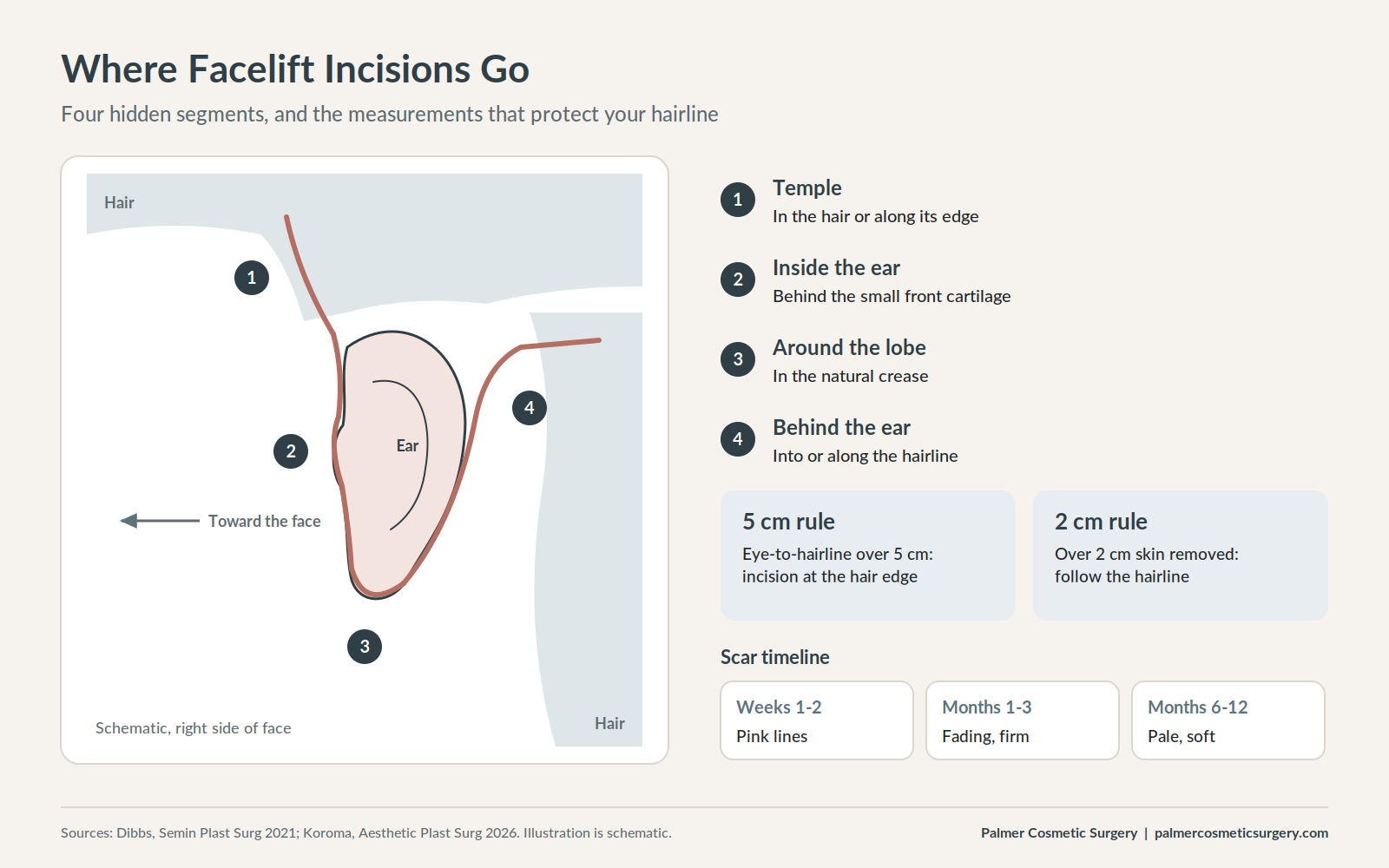
A facelift incision is one continuous line, but it's easiest to understand in four parts.
1. The temple. It starts near the temple, either inside the hair or along the front edge of the hairline. This is where the most careful planning happens. More on that below.
2. In front of the ear. It runs down the front of the ear, following its natural curve. Dr. Palmer places this part inside the ear. Instead of a line on your cheek, it tucks just behind the small bump of cartilage at the front of the ear opening. Surgeons call this a retrotragal incision.
3. Around the earlobe. It curves around the bottom of the earlobe, where a crease already exists.
4. Behind the ear. It goes up the back of the ear in the fold between the ear and the head. Then it turns back into the hair, or runs along the lower edge of the hairline.
For a neck lift, there may also be a small incision under the chin, in the natural crease there.
The rules that protect your hairline
Here's something most people never hear about. Surgeons don't just guess where the temple and back incisions should go. There are working rules for it.
A 2021 review in Seminars in Plastic Surgery lays them out (Dibbs et al.).
The temple
When the face is lifted, the skin at the temple moves up and back. If the incision is hidden deep in the hair, the sideburn and hairline move too. Lift too much that way, and the sideburn can end up too high or the temple can look bald.
So surgeons measure. They estimate how far your hairline will sit from the outer corner of your eye after the lift.
Under 5 cm: the incision can usually hide inside the hair.
Over 5 cm: the incision goes along the front edge of the hairline instead, so the hairline doesn't shift back.
A related rule: if your sideburn already sits high, above where the top of your ear joins your head, the surgeon may run a short incision under the sideburn to keep it from rising further.
Behind the ear
The same idea applies to the back.
Less than 2 cm of skin removed: the incision can usually go straight back into the hair.
More than 2 cm: it follows the edge of the hairline. That prevents a "step" in the hairline at the back of the neck.
This is why a facelift on someone with very loose neck skin may look a little different behind the ear than one on someone with mild laxity.
Angled cuts that let hair grow through
When an incision runs along the hairline, many surgeons cut at a slight angle. This is called a beveled incision. It lets hair follicles grow through the scar, which helps hide it even more (Dibbs et al.).
Why the deep plane helps your scars
A scar's worst enemy is tension. When skin is pulled tight and stitched under strain, the scar tends to widen or thicken.
In a deep plane facelift, the lift happens in the deeper layer under the skin. That layer carries the load. The skin is then laid back gently and trimmed, without being stretched. Less pull on the skin edge gives a thinner, flatter scar, and it helps avoid the stretched earlobe or "windswept" look.
The numbers are reassuring. A 2026 review of 10,784 deep plane facelift patients found raised, thickened scars in 2.8% (Koroma et al., Aesthetic Plastic Surgery).
Dr. Palmer's Tri-Nova Deep Plane Facelift uses this same principle across the neck, jawline and lower face.
New ideas in hairline-friendly incisions
Surgeons keep refining how to protect the temple. One 2026 study followed 400 women who had a facelift or cheek lift with an incision designed to keep the temple hairline and sideburn in place. At 12 months, 98% said they were very satisfied and would recommend it. A few had wider or raised scars, and all of those settled without lasting problems (Okumuş, Aesthetic Plastic Surgery).
The takeaway isn't that one incision is best for everyone. It's that a good plan starts with your hairline, your ear shape your skin, and your goals.
Do shorter lifts mean shorter scars?
Sometimes. It depends on how much needs lifting.
A mini or limited-incision facelift usually uses a shorter line, mostly around the front of the ear. It suits people with early jowls and little neck looseness. The trade-off is a smaller lift, especially in the neck.
A neck lift on its own often uses a small incision under the chin and short incisions behind the ears. Less complex neck lifts can even be done under local anesthesia.
A full deep plane facelift uses the complete path, because it lifts the neck, jawline and lower face together. The longer incision is what makes a bigger, longer-lasting change possible. And since the line follows natural folds, length matters less than placement.
Our guide to types of facelifts compares these options in more detail. For many people in their 50s and 60s, the full lift gives the most natural result. A shorter scar isn't worth much if the neck still looks older than the face.
How facelift scars heal
Weeks 1 to 2. The incision lines are closed and may look pink or slightly raised. There may be some crusting. Most people return to work in one to two weeks. Hair worn down hides most of it.
Months 1 to 3. Lines turn pink to light red. They may feel a bit firm. This is normal healing. Many people are comfortable wearing their hair up by the end of this window, though some like to wait a little longer.
Months 6 to 12. Scars fade to pale and soften. By about a year, they usually blend in with natural creases. Most people have to point them out for others to see them.
How you heal depends on your skin, genetics and habits. Not smoking, protecting the area from sun, and following your aftercare all help.

Facelift by Dr. Russel Palmer. Individual results vary.
Simple ways to help your scars
Protect them from sun. UV light can darken a healing scar. Use a hat and, once cleared, sunscreen.
Don't smoke or vape. Nicotine reduces blood flow to healing skin.
Keep follow-up visits. Your team checks how the incisions are closing and can step in early if anything looks off.
Ask before using scar creams. Some help. The timing matters.
Be gentle with hair tools. Hot dryers and tight ponytails can stress healing skin in the first weeks.
Follow-up visits at Palmer Cosmetic Surgery are included at no extra cost, and the team is reachable if you have a concern.
Questions to bring to your consultation
Where exactly will my incisions be?
Will my front incision be inside my ear?
Will my sideburn or hairline move, and how will you prevent that?
How much skin will you remove behind my ear?
Will I need an incision under my chin?
When can I wear my hair up?
Frequently asked questions
Where are facelift incisions?
They usually start near the temple, run down in front of the ear, wrap around the earlobe, and continue behind the ear into or along the hairline.
Are facelift scars noticeable?
Not usually, once healed. They follow natural creases and hairlines, and most fade to pale lines over 6 to 12 months.
Can I wear my hair up after a facelift?
Yes. Many people feel comfortable wearing their hair up after a few months, once the scars have started to fade.
Will a facelift change my hairline?
A careful plan protects it. Surgeons measure the space between your eye and hairline to decide where the temple incision goes, so your sideburn doesn't move too far.
Does a deep plane facelift leave less scarring?
The incisions are similar. But because the deeper layer holds the lift, the skin isn't pulled tight. That helps scars heal thinner and flatter.
Natural facelift results
A natural facelift should hide its own tracks. Dr. Palmer will look at your hairline, ears and skin, then show you exactly where your incisions would go. Book a private consultation at our office in Fort Lauderdale, or call (954) 989-5001. Financing options are available. Browse facelift results, and see our guide to facelift recovery in week 2.
Sources
Dibbs RP, et al. Revision Facelift and Neck Lift. Seminars in Plastic Surgery. 2021.
Koroma P, et al. Deep Plane Facelifts: A Systematic Review and Meta-Analysis of Outcomes. Aesthetic Plastic Surgery. 2026.
Okumuş A. The Okumus Incision: A Hairline-Preserving Temporozygomatic Approach for Facelift Surgery. Aesthetic Plastic Surgery. 2026.
American Society of Plastic Surgeons. Facelift.