


Breast Lift Without Implants: How Much Lift Your Own Tissue Can Hold
Content
Many women considering a breast lift ask the same question early on. "Do I really need implants?"
It's a good question. Lots of women want their breasts higher and perkier, but not bigger. They'd rather not have implants to look after for the rest of their lives. And plenty of them get a beautiful result with a lift alone.
For others, a lift alone can leave the top of the breast looking flatter than they'd like. The answer depends on two things: how much your breasts have dropped, and how much tissue you have to work with.
Dr. Russel Palmer, a board-certified plastic surgeon in Fort Lauderdale, performs breast lifts with and without implants. This guide walks through how to tell which fits you.
Key takeaways
A breast lift raises and reshapes the breast. It doesn't add volume or fill the upper breast on its own.
A lift alone usually makes the breasts about one cup smaller, because loose skin is removed.
Women with mild to moderate sagging and a B to D cup often do very well with a lift alone.
In a review of 1,888 women who had a lift without implants, only 1.3% were unhappy with their breast shape.
Implants add weight, which can contribute to sagging coming back. Skipping them keeps the breast lighter.
What a breast lift can and can't do
A breast lift raises the breast tissue and the nipple higher on the chest. It removes stretched skin and reshapes the breast into a firmer, rounder form. It can also make large, stretched areolas smaller.
What it doesn't do is add volume. The American Society of Plastic Surgeons notes that a lift doesn't significantly change breast size, and doesn't round out the upper part of the breast (ASPS: Breast Lift).
In fact, a lift alone usually makes the breast a little smaller. Removing loose skin and tightening the shape tends to bring the breast down about one cup size (Ramanadham et al., PRS Global Open). Many women like that. The breast looks perkier and more proportional.
How surgeons grade sagging
Sagging is described in grades, based on where the nipple sits compared with the fold under the breast.
Grade 1 (mild). The nipple sits at the level of the fold.
Grade 2 (moderate). The nipple sits below the fold, but above the lowest part of the breast.
Grade 3 (severe). The nipple sits at the lowest point of the breast and points down.
Pseudoptosis. The nipple is in a good spot, but the breast tissue has slid below the fold. The breast looks "bottom-heavy."
The grade helps decide the incision pattern and whether a lift alone will give you the look you want.
Who does best with a lift alone
A 2026 study followed 488 women who had a lift that kept all their breast tissue and used no implants. Over two years, complications were low at 2.5%. The authors said this kind of lift suited women with cup sizes A to D and grade 1 to 2 sagging (Ionescu et al., Aesthetic Surgery Journal Open Forum).
You may be a great fit for a lift without implants if:
You're happy with your current size, or would like to be a bit smaller
You have mild to moderate sagging
You still have a fair amount of breast tissue
You'd rather avoid implants and their future maintenance
Your main goal is perkier, higher breasts
A lift with an implant, or with fat transfer, may suit you better if:
You've lost a lot of fullness, especially at the top of the breast
Your breasts feel "empty" after pregnancy, nursing or weight loss
You'd like to be larger than you are now
You have very little breast tissue
Our post on breast lift with augmentation covers that path. If you'd like more fullness without an implant, see fat transfer breast augmentation.
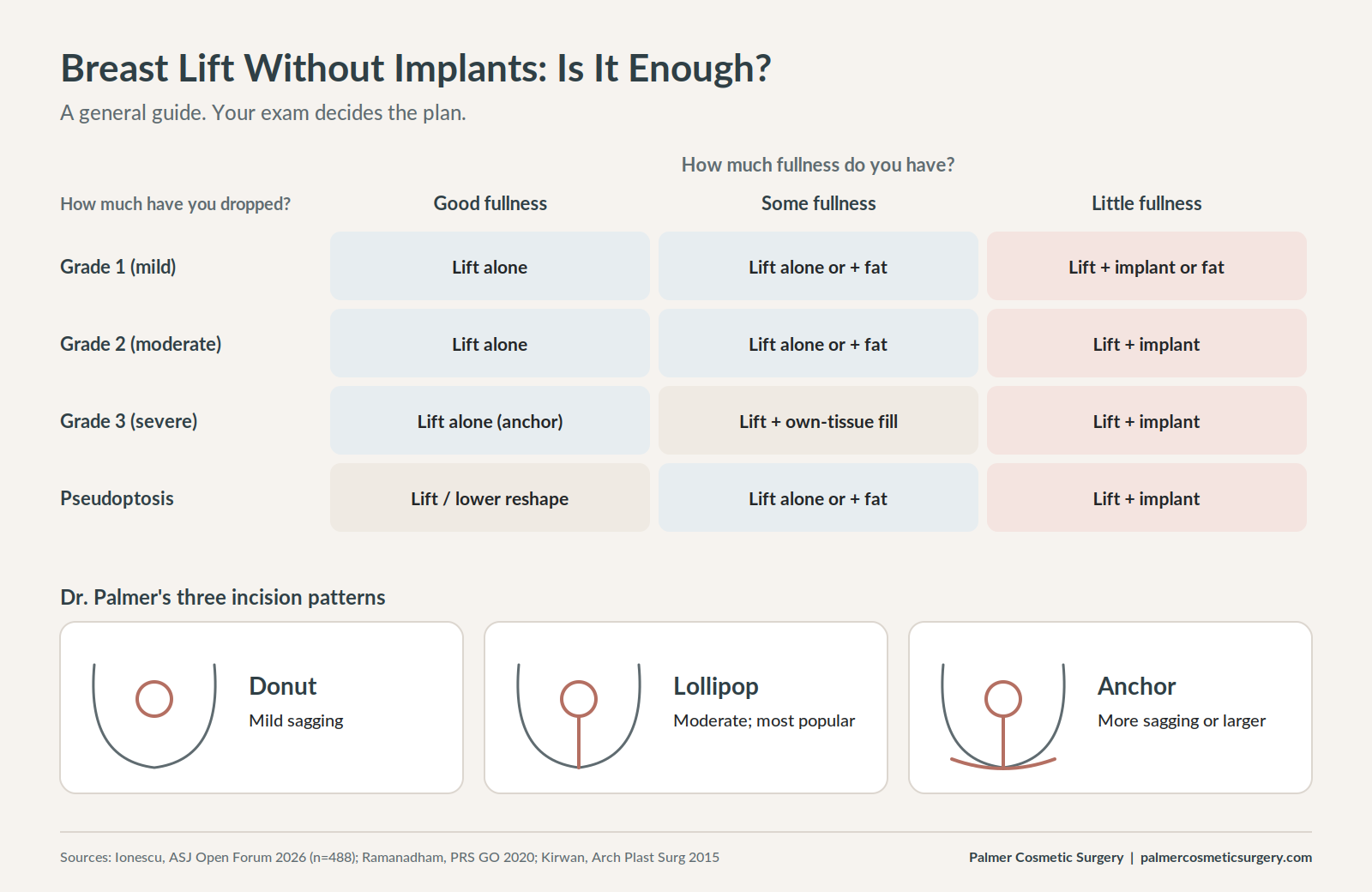 Decision grid by sagging grade and fullness pointing to lift alone, lift plus fat, own-tissue fill or lift plus implant, plus the donut, lollipop and anchor incision patterns.
Using your own tissue for fullness
Here's a detail many women haven't heard about. Sometimes a surgeon can use your own lower breast tissue to add shape at the top.
The technique is sometimes called auto-augmentation. Tissue from the lower part of the breast, which would otherwise be removed, is folded up and tucked higher. It adds a bit of upper fullness without an implant.
In one series of 107 breasts, this worked well for women with small breasts and sagging, as long as there was enough tissue in the lower breast. The nipple was lifted by an average of 8 cm. Most healed without any problems (Kirwan et al., Archives of Plastic Surgery).
It's not for everyone. If there isn't much tissue below the nipple, there isn't much to move. Dr. Palmer can tell you if your breast has enough to work with.
Why skipping implants can help the lift last
Implants add weight. Over time, that weight pulls on the skin, and the breast can start to sag again. A 2020 review listed implant weight as one of the factors behind recurrent sagging after a combined lift and augmentation (Ramanadham et al.).
The same review found revision rates were higher when lifts and implants were combined (12.4%) than when each was done on its own (7.97%).
That doesn't make implants a bad choice. For many women, they're exactly the right one. It just means a lift alone has a real advantage if your shape can carry it.
It's also normal for a lifted breast to settle a little. In the 488-woman study, the nipple and lower breast settled slightly between one month and two years, but the nipple stayed about 4.5 cm higher than before surgery on average (Ionescu et al.). Most surgeons plan for this by building in a little extra lift.
The three incision patterns
Dr. Palmer chooses the incision based on how much lift you need.
Donut (around the areola). For mild sagging. The incision circles the edge of the areola. It can also make a stretched areola smaller.
Lollipop (around the areola and straight down). For moderate sagging. This is the most popular pattern. It reshapes the lower breast without a long scar in the fold.
Anchor (around, down and along the fold). For more severe sagging or larger breasts. It allows the most reshaping.
In each case, the nipple and areola stay attached to the breast tissue underneath. That helps preserve sensation and the milk ducts.
 Breast lift by Dr. Russel Palmer. Individual results vary.
What the research says about lifts alone
A 2019 review gathered 34 studies and 1,888 women who had a breast lift without implants. The overall complication rate was 10.4%, mostly minor. Only 1.3% were unhappy with their breast shape. Scar problems happened in 3%, and nipple-related issues like asymmetry or changed feeling in 2.9%. The authors concluded these lifts bring high satisfaction with relatively low risk (di Summa et al., Journal of Plastic, Reconstructive & Aesthetic Surgery).
Surgery and recovery
Dr. Palmer performs breast lifts under IV sedation, not general anesthesia. You're asleep and comfortable, and you breathe on your own. Surgery usually takes two to three hours. No drains are used.
Days 1 to 5. Rest at home. Most women return to work in three to five days.
Weeks 2 to 4. Avoid intense activity and heavy lifting.
Month 1. Wear a supportive garment day and night.
Months 3 to 6. Swelling settles and your final shape appears.
Results typically last 10 to 15 years, depending on weight changes, pregnancy and aging. If you're over 50, you may need a mammogram or an EKG before surgery.
Follow-up visits are included at no extra cost, and our team is always available to you.
Protecting your result
A breast lift isn't frozen in time. Your breasts will keep aging, just from a much better starting point. A few habits help the result last:
Keep your weight steady. Big swings stretch the skin again.
Wear good support. A well-fitted bra, especially during exercise, takes strain off healing tissue.
Plan around pregnancy. If you may have more children, it's often worth waiting. Pregnancy and nursing can change the shape again.
Don't smoke. Nicotine slows healing and can affect scars.
Protect your scars from sun while they're still pink.
Questions to bring to your consultation
What grade is my sagging?
Will a lift alone give me the upper fullness I want?
Do I have enough tissue for an auto-augmentation?
Which incision pattern will I need?
How much smaller will I be after a lift alone?
How long will my result last, and what can I do to protect it?
Frequently asked questions
Can you get a breast lift without implants?
Yes. Many women have a lift alone, especially with mild to moderate sagging and good breast tissue.
Will a breast lift make my breasts smaller?
Usually a little. A lift alone tends to reduce size by about one cup, because loose skin is removed and the shape is tightened.
Will a breast lift give me upper fullness?
A lift alone doesn't add much upper fullness. Some women get more shape at the top by moving their own lower breast tissue upward. Others add fat transfer or an implant.
How long does a breast lift last without implants?
Results typically last 10 to 15 years. Weight changes, pregnancy and aging can affect them.
Can I breastfeed after a breast lift?
The nipple and areola stay attached to the tissue underneath, which helps preserve the milk ducts. Ask about your specific plan if future nursing matters to you.
Lift without adding
A higher, firmer shape may be closer than you think, with no implants needed. Dr. Palmer will look at your breasts, talk about your goals, and explain whether a lift alone will give you the look you want. Book a private consultation at our office at 2699 Stirling Road, Suite B101, in Fort Lauderdale, or call (954) 989-5001. Financing options are available. Browse breast lift results and learn more about breast lifts at Palmer Cosmetic Surgery.
Sources
American Society of Plastic Surgeons. Breast Lift.
Ramanadham SR, et al. Breast Lift with and without Implant: A Synopsis and Primer for the Plastic Surgeon. Plastic and Reconstructive Surgery Global Open. 2020.
Ionescu R, et al. Total Pedicle Preservation Mastopexy: Technique, Safety, and Long-term Results. Aesthetic Surgery Journal Open Forum. 2026.
Kirwan L, et al. Breast Auto-Augmentation: A Versatile Method of Breast Rehabilitation. Archives of Plastic Surgery. 2015.
di Summa PG, et al. Systematic Review of Outcomes and Complications in Nonimplant-Based Mastopexy Surgery. Journal of Plastic, Reconstructive & Aesthetic Surgery. 2019.
This article is for educational purposes and isn't a substitute for an individual medical evaluation. Individual results vary.